
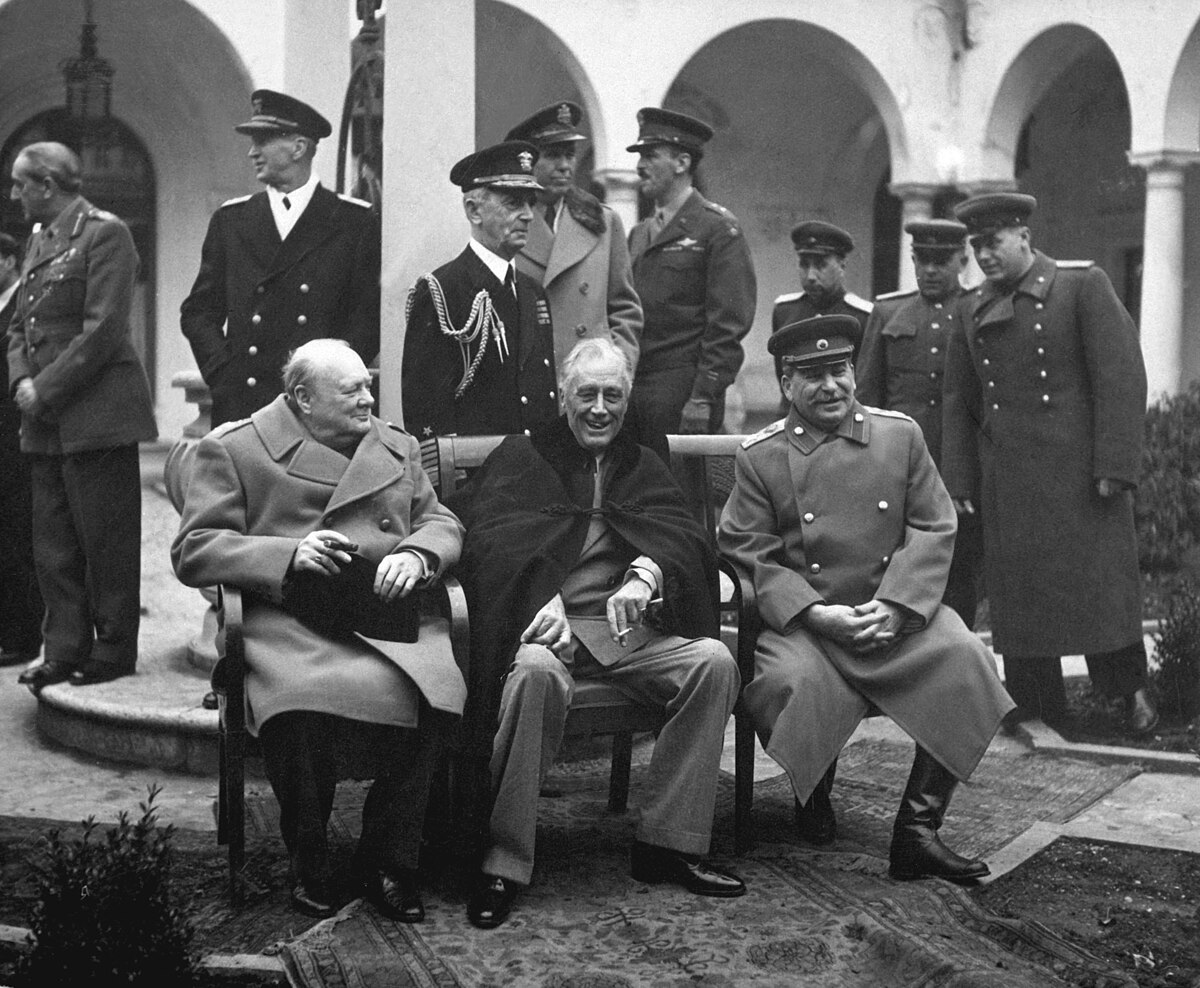
British PM the Rt. Hon. Winston L. Spencer-Churchill (CP), Pres. Franklin D. Roosevelt (D-NY), Soviet Premier Joseph V. J. Stalin, and the CCS at Yalta. Already in poor health, Roosevelt dies shortly after on 12 April.
Directive No. 3 for the Strategic Air Forces in Europe is taken from:
Assistant Chief of Air Staff, Plans. “Directive No. 3 for the Strategic Air Forces in Europe,” 12 January 1945. Strategic Employment Directives. Air Force Historical Research Agency, Reel A1377.
These papers have been reproduced as originally written, with spelling corrections and editorial additions highlighted and bracketed in blue. If you find any errors in my transcription, please do not hesitate to contact me.
DIRECTIVE NO. 3 FOR THE STRATEGIC
AIR FORCES IN EUROPE
12 JANUARY 1945
General Mission
1. In accordance with instructions received from the Combined Chiefs of Staff, the overall mission of the Strategic Air Forces remains the progressive destruction and dislocation of the German military, industrial and economic systems and the direct support of land and naval forces.
Priorities of Objectives
2. Under this general mission you are to direct your strategic attacks, subject to exigencies of weather and tactical feasibility, against the following systems of objectives:
First Priority
(1) Petroleum Industry, with special emphasis on petrol (gasoline) including storage
Second Priority
(1) The German lines of communications:
The operations of the Strategic Air Forces are to be directed against enemy lines of communication: Those based in the United Kingdom will place particular emphasis on the Ruhr.
Important Industrial Areas
3. When weather or tactical conditions are unsuitable for operations against the systems of objectives mentioned above, attacks are to be delivered on important industrial areas with blind bombing technique as necessary. As far as operational and other conditions allow, these are to be directed as as to contribute to the maximum destruction of the petroleum industry and the dislocation of the target systems indicated above.
Counter Air Forces Action
4. Largely as a result of the concentration of our strategic bomber effort on the enemy’s petroleum industry and his communication system, and due to our preoccupation on the battlefront, we have allowed the GAF to recover a great deal of its fighting strength. However, the enemy has concentrated his efforts particularly on developing his fighter force at the
expense of other branches of the GAF. In this effort to increase the efficiency of his fighter force, he has turned to the rapid development of jet fighters and there is every evidence of his intention to produce them on a large scale as early as possible.
Already he has a considerable number of these aircraft in operation. They are superior in speed and armament to our conventional fighters. As soon as they are available in sufficient numbers, and as soon as the enemy has developed suitable tactics for their efficient employment, they will doubtless be employed systematically against our strategic day bombers. The conditions which are likely to confront the conduct of our strategic offensive in the near future are therefore serious, unless the enemy’s destruction and employment of jet aircraft is checked in some way.
In addition, the employment of these aircraft over the battlefront will place our tactical air forces and the armies themselves at a considerable disadvantage. This particularly applies to reconnaissance and to the employment of those aircraft in the ground attack role. The GAF and particularly its jet production, training and experimental establishments now become priority objectives for attack.
Direct Support
5. The direct support of land and naval operations remain a continuing commitment.
Attack of Enemy U-Boat Production
6. In view of the growing menace of the German U-Boat developments, it has been decided that certain objectives in the enemy’s O-Boat organization will be attacked whenever possible by marginal effort or incidental to operations covered by the preceding paragraphs in this directive.
S. O. E. Operations
7. All S.O.E./S.O.S. operations will be in accordance with existing instructions and procedure.
Targets and Target priorities
8. The list of targets best calculated to achieve the aims set out above and the relative priorities accorded them, will be issued separately. These priorities will be adjusted from time to time in accordance with the situation.
Coordination
9. The procedure as at present established for the coordination of operations between the various Air Forces will continue.
[Document drafted by LTG Carl A. Spaatz, CG USSTAF and DCAS AVM Sir Norman H. Bottomley]
FROM: S.H.A.E.F. MAIN DSC (D.C.A.S.)
TO FOR ACTION:
(1) AIR OFFICER COMMAND, MALTA;
(2) HEADQUARTERS, USSTAF (MAIN);
(3) AIR MINISTRY, WHITEHALL.
CLASSIFICATION – TOP SECRET
(1) Please pass to “CRICKET” personal for Chief of the Air Staff;
(2) For Spaatz;
(3) for Vice Chief of the Air Staff from Deputy Chief of the Air Staff.
You will wish [t]o know that, following your talk with Spaatz and myself and as a result of discussions with Tedder, we have arrived at the following order of Priorities for Strategic Air Forces to meet the present situation. You know, however, that these priorities will be primarily determined by weather conditions:
(A) Main synthetic oil plants continue to hold First Priority for all Strategic Air Forces. They will be attacked by day whenever visual conditions are anticipated.
(B) Next in order of Priority for Air Forces operating in the United Kingdom is attack of Berlin, Leipzig, Dresden and associated cities where heavy attack will cause great confusion in civilian evacuation from the East and hamper movement of reinforcements from other fronts. Spaatz has already ordered day attacks to be made on Berlin whenever weather conditions permit. You know the intentions of Bomber Command.
(C) Next in order of Priority is attack of communications, particularly as affecting reinforcements to the East and as affecting current and impending land operations. For Strategic Air Forces in United Kingdom attacks are now being dispersed particularly against targets in the Ruhr-Colonge-Kassel area. Fifteen Air Force has been directed to pay particular attention to any signs of transfers of forces and will attack appropriate communications centres as necessary.
(D) Attack of Jet Targets and communications in South German area.
Marginal effort will be directed on tank factories and submarine yards. Marginal effort on tank factories is likely to be substantial since these constitute convenient “FILLER” targets in areas of
Priority Oil Targets.
In addition, the Priority task of the Strategic day fighters after the escort of bombers is the attack of rail movement on the main routes of reinforcement to the East.
In view of the rapid Russian advance, particularly towards Berlin, the Russians may wish to know our intentions and plans for attack of targets in Eastern Germany. The Combined Chiefs of Staff will doubtless be considering this situation and we assume will inform Spaatz and myself as to any limitations on the operations already ordered for USSTAF and Bomber Command.
Spaatz asks that Kuter be informed of this signal.
N. H. Bottomley – Air Marshal
[Bottomley’s revision was written on 31 January 1945]